Buying land sounds simple until you actually start comparing properties.
One plot may look incredibly cheap because it is agricultural land. Another may cost much more because it is approved for residential use. On paper, the cheaper option can appear to offer the better return. But land investment is not only about the price you pay today.
The bigger questions are: Can you legally use the land the way you want? How easy will it be to sell later? What development is coming nearby? And how much work will be required before the land becomes genuinely useful to another buyer?
This is where the debate around agricultural land vs residential land becomes important.
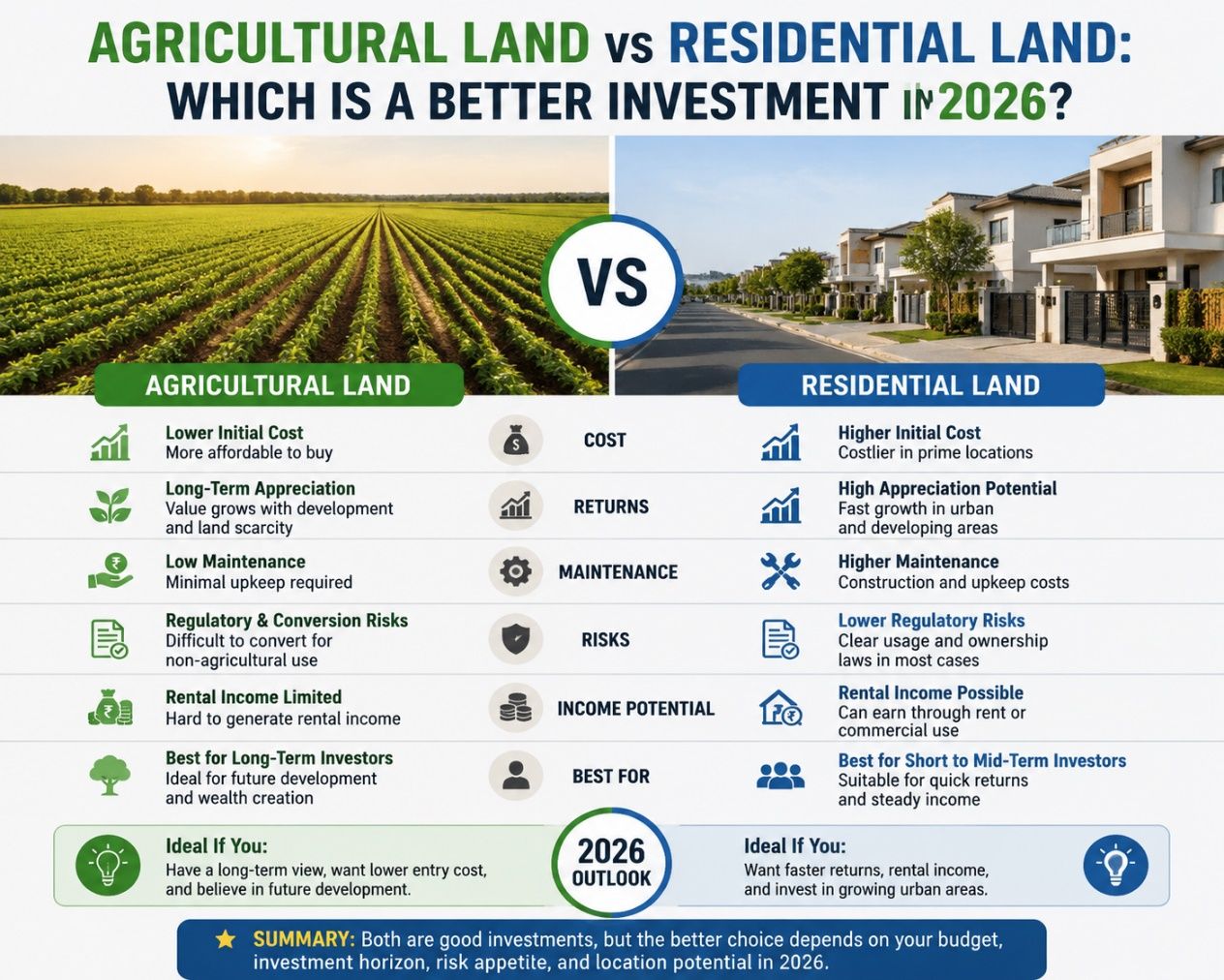
In 2026, both can be interesting investment options, but they suit different types of investors. Agricultural land may offer a lower entry price and long-term appreciation potential in developing areas. Residential land, on the other hand, generally has a wider pool of buyers and a clearer end-use.
So, which one is better?
There is no universal answer. The right choice depends on your budget, location, investment horizon, intended use and tolerance for legal and liquidity-related complications.
Agricultural Land vs Residential Land: What Is the Basic Difference?
The first thing to understand is that these two types of land are not interchangeable.
Agricultural land is generally classified for farming and related agricultural activities. Depending on the state and local rules, restrictions may apply to construction, sale to certain categories of buyers, land fragmentation and non-agricultural use.
Residential land is intended for housing or residential development, subject to the applicable master plan, zoning rules, approvals and local regulations.
That distinction matters.
Imagine buying an agricultural plot because you have seen houses coming up around it. It may seem logical to assume that you can eventually build your own house there. However, surrounding development does not automatically change the legal land-use classification of your property.
You may need land-use conversion or other permissions before using it for residential purposes.
And that is where many first-time land buyers get caught out.
Which Gives Better Returns in 2026?
When people compare agricultural land and residential land, returns are usually the first thing they look at.
Agricultural land can sometimes have a lower purchase price, particularly outside established urban areas. If a city expands towards that location, new roads are developed and nearby residential or commercial activity increases, the land may appreciate significantly over several years.
But there is a catch.
High potential appreciation does not mean guaranteed appreciation.
A piece of agricultural land sitting 20 kilometres outside a city is not automatically going to become a valuable urban plot. The development needs to actually reach that location.
Look at what is happening around the property. Is there a new highway? An industrial corridor? A planned township? A railway or metro expansion? New schools, hospitals or employment centres?
These things can matter more than a seller saying, “The area will develop soon.”
Residential plots can also appreciate strongly, particularly when they are located inside established or expanding residential sectors. Their advantage is that buyers are often purchasing for a clear purpose: building a home, holding the plot or developing it according to permitted use.
So, in simple terms:
Agricultural land may offer higher upside in the right location, but residential land generally offers greater predictability.
The Hidden Issue: Land Conversion
This is probably the most important point to understand before buying agricultural land for future residential use.
Suppose you find agricultural land at ₹X per square yard while a residential plot nearby costs considerably more. The price difference can look tempting.
However, ask why the difference exists.
Agricultural land may require conversion to non-agricultural or residential use, depending on the state and local rules. The process can involve applications, fees, permissions and compliance with planning regulations.
The rules are not identical across India. They can vary by state, district, development authority and even the location of the land.
Therefore, never assume:
“I will buy agricultural land now and convert it whenever I want.”
That may not be legally or practically possible in the way you expect.
Before paying a token amount, verify the land-use classification and ask the relevant revenue or planning authority whether conversion is permitted.
Also check whether the land falls within a controlled area, development plan, green zone, restricted zone or another category that affects future use.
This is one reason a slightly more expensive residential plot can sometimes be the more sensible investment.

What About Liquidity?
Liquidity is often overlooked when people buy land.
It simply means how easily you can sell the asset when you need money.
Residential plots generally have a broader buyer base because many buyers understand the purpose immediately. Someone looking for a plot to construct a house may specifically search for residential land.
Agricultural land can have a narrower market.
The buyer may need to understand agricultural land rules, eligibility requirements, access roads, irrigation, title records and future conversion possibilities. In some locations, this makes the resale process slower.
However, location can completely change the picture.
A well-connected agricultural parcel close to a rapidly growing city may attract investors, developers or farmers. Conversely, an isolated residential plot with poor access may remain unsold for years.
So don't judge liquidity only by the word “residential” or “agricultural”.
Location, legal status, road access, demand and documentation all influence resale.
A Realistic Buyer Situation
Consider two buyers.
The first buyer has a limited budget and does not need to sell the property for the next 10 to 15 years. She finds agricultural land on the outskirts of a growing city. A major road is being developed nearby, employment activity is increasing and residential projects are gradually moving towards the area.
For her, agricultural land could make sense—provided the title is clear and the purchase is legally permitted.
The second buyer wants to build a house within the next three to five years. He buys agricultural land because it is cheaper, expecting to convert it later.
That is a completely different situation.
For him, residential land may be the safer choice because the intended use is already aligned more closely with the property's classification.
This is why asking “Which is better?” without asking “Better for whom?” can lead to a misleading answer.
Long-Term Potential: Look Beyond Today's Price
Land is a long-term asset. Because of that, today's surroundings can tell you only part of the story.
When evaluating agricultural land, pay attention to development patterns.
A useful approach is to spend time physically exploring the area rather than relying entirely on a property listing.
Drive around the property.
Check the road condition. Look at nearby construction. Speak to local residents if appropriate. Notice whether shops, schools, warehouses or housing projects are appearing nearby.
Sometimes a five-minute conversation with someone living in the area tells you something a brochure never will.
For residential land, look at the same fundamentals but add another layer: approved layouts, roads, drainage, electricity, water supply and the surrounding residential environment.
After all, a plot becomes more attractive when a future buyer can actually imagine living there.
Agricultural Land: Advantages and Risks
Agricultural land can be attractive for investors with a long investment horizon.
Potential advantages
Lower entry prices in some locations
Potential appreciation when urban development moves towards the area
Larger parcels may be available
Possible agricultural use and income, depending on the property and local rules
Long-term land scarcity can support value in developing regions
However, the risks deserve equal attention.
You may face restrictions on construction, land conversion, ownership eligibility, subdivision or resale. Agricultural land can also be more difficult to finance through conventional home-loan products.
There can also be practical issues such as unclear boundaries, access-road disputes, tenancy claims or incomplete revenue records.
In other words, cheap land is not necessarily bargain land.
Residential Land: Advantages and Risks
Residential plots are generally easier for buyers to understand because their intended purpose is clearer.
Potential advantages
Wider resale market in many urban and suburban locations
Easier comparison with nearby residential properties
Suitable for home construction subject to applicable approvals
Often better connectivity and infrastructure
Potentially easier exit when demand is strong
The downside is the initial price.
Good residential land in a developed location can be expensive. Some investors may therefore find that the appreciation percentage is lower than that of a strategically located agricultural parcel purchased early in an area's growth cycle.
There are also risks. A residential plot can still have title issues, planning restrictions, unpaid dues or access problems.
So residential does not mean risk-free.
Agricultural Land vs Residential Land: Quick Comparison
Factor | Agricultural Land | Residential Land |
Entry price | Often lower in developing areas | Usually higher in established locations |
Construction | Restrictions may apply | Generally permitted subject to rules |
Conversion | May be required for non-agricultural use | Usually already residentially classified |
Liquidity | Can be lower depending on location | Often broader buyer demand |
Long-term potential | High in the right growth corridor | Strong where residential demand is growing |
Due diligence | Requires careful revenue and land-use checks | Requires title, layout and planning checks |
Suitable for | Patient, long-term investors | Home buyers and investors seeking clearer use |
Risk level | Can be higher because of restrictions | Generally easier to understand, but still location-dependent |
What Should You Check Before Buying Either One?
Regardless of the type of land, don't skip due diligence.
Start with the title. Confirm who legally owns the property and whether previous transactions are properly recorded.
Then check the relevant land and revenue records. Verify the survey or khasra number, boundaries and area.
Next, investigate whether there are mortgages, liens, court disputes, acquisition notices or other claims.
For residential land, verify the approved layout and development permissions where applicable.
For agricultural land, pay particular attention to land-use classification and conversion rules.
Road access deserves special attention too.
A property may look perfect on a map, but the actual access route can be completely different. If the approach road is disputed or privately controlled, resale can become difficult.
Finally, get professional legal advice before completing a significant transaction. Property laws differ between states, and a local property lawyer can identify issues that a general online article cannot.
Which Is Better for a 5-Year Investment?
If your investment horizon is around five years, residential land may be easier to evaluate because you can focus on existing infrastructure, current demand and near-term development.
Agricultural land can still perform well, but the investment thesis may depend more heavily on future urban expansion.
That makes it more speculative.
Therefore, if you need relatively predictable usability and a clearer resale market, residential land may have an advantage.
Which Is Better for a 10–15 Year Investment?
For a longer horizon, the answer becomes more interesting.
Agricultural land in the path of genuine urban expansion can potentially deliver substantial appreciation. But you have to identify the growth corridor correctly.
This is where patience matters.
Buying land simply because someone says “the government is planning a highway nearby” is not enough. Check whether the project is officially planned, what stage it has reached and whether it is actually close enough to affect the property.
Residential land can also deliver strong long-term returns, particularly when population growth, employment and infrastructure continue to support the area.
For long-term investors, the quality of the location matters more than the label on the land.

A Small but Important 2026 Reality Check
Property markets are changing faster than they used to.
Buyers now compare locations online before visiting them. Infrastructure announcements can influence expectations quickly, while actual development may take years.
Google's current Search guidance also emphasises original, useful and people-first information rather than content created mainly to manipulate rankings. For property websites, that means simply publishing dozens of generic “best property investment” articles is unlikely to be a strong long-term content strategy. Useful local analysis, accurate information and genuine explanations are far more valuable.
The same principle applies to land investment itself.
Don't buy based on hype.
Buy based on evidence.
So, Agricultural Land or Residential Land?
If you want a straightforward answer, here it is:
Residential land is generally the better choice for buyers who want clearer usability, stronger liquidity and a shorter or medium-term investment horizon.
Agricultural land can be the better choice for patient investors who understand land laws, can tolerate lower liquidity and have identified a location with credible long-term development potential.
Neither option is automatically superior.
A legally complicated piece of cheap agricultural land can be a worse investment than a more expensive residential plot in a strong location.
Likewise, an overpriced residential plot in an area with weak demand may not deliver the returns you expect.
The real question is not simply agricultural land vs residential land.
It is:
What is the land worth today, what can legally be done with it, who will want it tomorrow, and what evidence supports that future demand?
That is the question worth answering before you invest.
Frequently Asked Questions
Is agricultural land cheaper than residential land?
In many locations, agricultural land can have a lower purchase price than residential land. However, the difference depends heavily on location, road access, development potential and local regulations.
Can agricultural land be converted into residential land?
It may be possible in some locations, but conversion rules vary by state and local authority. Permission, fees and eligibility requirements may apply. Buyers should verify the current rules before purchasing.
Which has better resale value: agricultural or residential land?
Residential land often has a wider buyer pool, especially in established urban areas. Agricultural land can have strong resale potential in rapidly developing corridors, but liquidity may depend more heavily on its location and legal status.
Is agricultural land a good investment in 2026?
It can be, particularly for long-term investors who identify genuine infrastructure and urban-growth potential. However, returns are not guaranteed, and legal restrictions must be checked carefully.
Is residential land safer than agricultural land?
Residential land can be easier to understand because the intended use is clearer. However, both types require title verification, legal due diligence and an assessment of location-specific risks.