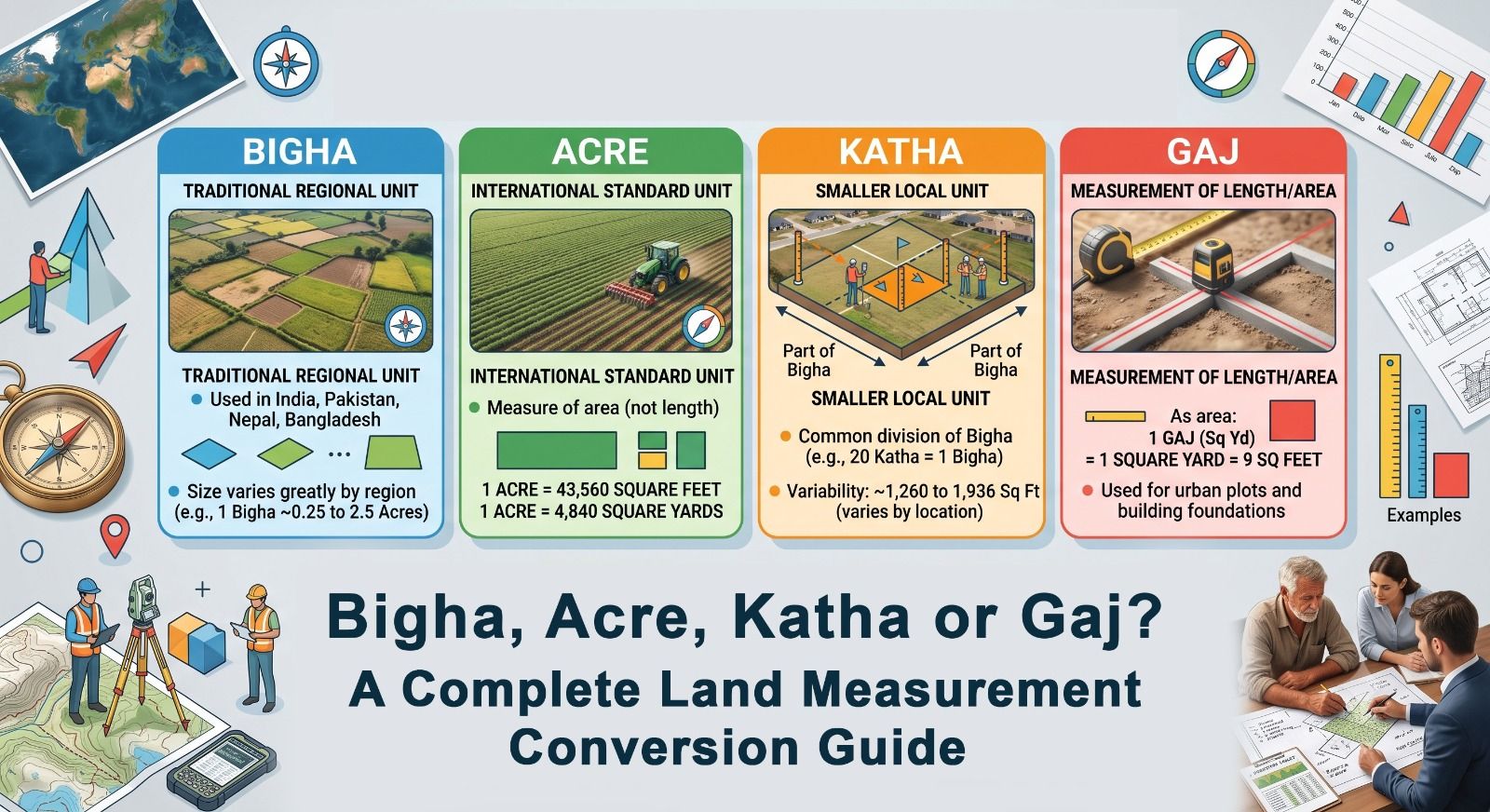
Confused between Bigha, Acre, Katha and Gaj ? Learn land measurement conversions, state-wise differences, and smart buying tips with this complete guide.
Buying land in India sounds simple—until someone tells you the plot is 12 Bigha, another broker quotes the same property in Acres, and the registration papers mention Square Metres.
Confusing?
You're not alone.
This is one of the biggest reasons buyers end up making expensive mistakes. Many people focus on the location, price, and future appreciation but overlook something much more basic—the unit of land measurement.
And that's where problems begin.
Imagine this.
You visit a village near Kurukshetra. The local farmer says the land is 5 Bigha. Later, a property consultant tells you it's around 3 acres. When you finally receive the official land records, the area is written in square metres.
Now you're left wondering...
"Are all these numbers talking about the same piece of land?"
The answer is yes—but only if the conversions are correct.
Understanding land measurement isn't just useful. It helps you compare prices fairly, avoid misunderstandings during negotiations, and verify government records before making one of the biggest financial decisions of your life.
Whether you're buying agricultural land, residential plots, commercial property, or investing for the future, this guide will help you understand every major land measurement unit used across India.
Let's make land measurements much easier than they usually seem.
Why Land Measurement Matters More Than Most Buyers Think
Many first-time buyers believe land measurement is just a technical detail.
It isn't.
It directly affects how much you're paying.
For example, two sellers may quote the exact same price per Bigha. However, if they're located in different states, the actual land area could be completely different because the size of a Bigha changes from region to region.
That means comparing prices without understanding measurements is like comparing apples and oranges.
One common situation buyers share is this:
They finalise a deal after hearing a price "per Bigha," only to discover during documentation that the local definition of a Bigha is much smaller than they assumed.
That's an expensive lesson.
A little knowledge before signing the papers can save lakhs of rupees later.
Why India Has So Many Different Land Measurement Units
Unlike many countries that use a single standard measurement system, India has centuries of regional land measurement traditions.
Different kingdoms, local administrations, and farming communities developed their own units long before the metric system became common.
Even today, local customs continue to influence property transactions.
That's why you'll hear terms such as:
Bigha
Acre
Katha
Gaj
Square Yard
Guntha
Kanal
Marla
Cent
Hectare
All of them measure land.
They just measure it differently.
Understanding the Most Common Land Measurement Units
1. Bigha
Bigha is probably the most commonly heard land measurement unit in North India.
You'll frequently come across it in:
Haryana
Punjab
Uttar Pradesh
Rajasthan
Himachal Pradesh
Uttarakhand
Bihar
Madhya Pradesh
Here's the interesting part.
There is no universal size for one Bigha.
Its actual area changes depending on the state—and sometimes even from one district to another.
That's why experienced buyers never rely only on the word "Bigha." They always ask:
"According to which state's measurement?"
A simple question like this can prevent major confusion.
2. Acre
Unlike Bigha, an Acre is internationally recognised and remains consistent everywhere.
One Acre equals:
43,560 square feet
4,840 square yards
4,046.86 square metres
Because it follows a standard measurement, Acres are widely used in:
Agricultural land transactions
Industrial projects
Government records
Large investment deals
Institutional land purchases
If you're comparing land in different states, Acres often provide the easiest reference point.
3. Katha
Katha is another traditional land measurement widely used in eastern and northern India.
You'll hear it frequently in:
Bihar
West Bengal
Assam
Jharkhand
Just like Bigha, the size of a Katha isn't fixed.
For example, one Katha in Bihar may represent a different area than one Katha in West Bengal.
That's why property buyers should never assume all Kathas are equal.
Always verify the local standard before calculating the price.
4. Gaj (Square Yard)
If you've searched for residential plots in cities, you've almost certainly heard the word Gaj.
In simple terms:
1 Gaj = 1 Square Yard = 9 Square Feet
Builders, developers, and property dealers commonly use Gaj when selling:
Residential plots
Independent houses
Builder floors
Small commercial plots
For example:
100 Gaj plot
150 Gaj plot
200 Gaj plot
250 Gaj plot
Most urban buyers are more familiar with Gaj than Acres or Bigha because it makes smaller plot sizes easier to visualise.
Square Feet – The Unit Almost Everyone Understands
Whether you're buying a flat, office, villa, or plot, square feet remains the most commonly used unit in India.
Its popularity comes from one reason.
Everyone understands it.
Builders advertise property in square feet.
Banks calculate valuations in square feet.
Interior designers estimate renovation costs in square feet.
Even flooring contractors work using square feet.
So even if someone quotes the land in Acres or Bigha, converting it into square feet often makes comparisons much easier.
Square Metre – The Official Government Standard
While buyers usually discuss Gaj or Bigha, government departments often use Square Metres during official registration.
You'll find square metres in:
Sale deeds
Revenue records
Municipal approvals
Registry documents
Development authority maps
This is why buyers should become comfortable reading both traditional and metric measurements.
It reduces confusion during document verification.
Land Measurement Conversion Table
Here's a quick reference that every buyer should bookmark.
Unit | Equivalent |
1 Acre | 43,560 Square Feet |
1 Acre | 4,840 Square Yards |
1 Square Yard | 9 Square Feet |
1 Gaj | 1 Square Yard |
1 Square Metre | 10.764 Square Feet |
1 Hectare | 2.471 Acres |
1 Acre | 0.4047 Hectare |
Remember, Bigha and Katha conversions vary by state, so always verify them locally.
State-Wise Differences You Should Never Ignore
This is where many buyers make mistakes.
They search online for "1 Bigha equals Acre," see one answer, and assume it applies everywhere.
Unfortunately, it doesn't.
For example, the size of a Bigha in Rajasthan is different from Haryana. Similarly, Bihar and Uttar Pradesh follow different local practices in several districts.
The same applies to Katha.
That's why experienced property investors never depend on a generic internet conversion.
Instead, they verify the exact unit mentioned in:
Revenue records
Jamabandi
Registry papers
Local Patwari records
Survey maps
It takes a few extra minutes.
But those few minutes can save months of legal complications later.
A Small Story That Explains Why This Matters
A buyer from Delhi recently visited a village looking for agricultural land.
The seller confidently said,
"It's six Bigha."
The buyer calculated the price using Delhi's understanding of Bigha and agreed almost immediately.
A week later, while reviewing official records, he realised the village followed a completely different measurement.
The land wasn't smaller.
His calculation was wrong.
Fortunately, this was discovered before registration.
Had the documents already been signed, renegotiating the deal would have been extremely difficult.
Stories like this aren't unusual.
They happen more often than people think.
As we discussed earlier, Bigha and Katha are not standard units across India. Their size depends on the state—and sometimes even the district. That's why experienced buyers rarely rely on verbal claims alone. They verify the land area using official records before making any payment.
Instead of memorising every local variation, use the following table as a quick reference. However, always cross-check with the local revenue department because measurements may differ slightly from one region to another.
State-Wise Land Measurement Variations
State | Common Unit | Approximate Value |
Haryana | Bigha | Around 27,225 sq. ft. |
Punjab | Kanal, Marla | 1 Kanal = 20 Marla |
Uttar Pradesh | Bigha | Varies by district |
Rajasthan | Bigha | Varies significantly |
Bihar | Katha, Bigha | Local variations exist |
West Bengal | Katha | Different from Bihar |
Assam | Katha | Regional variation |
Maharashtra | Guntha | 40 Guntha = 1 Acre |
Karnataka | Acre, Gunta | Common in agricultural land |
Tamil Nadu | Cent | 100 Cents = 1 Acre |
Kerala | Cent | Widely used |
Andhra Pradesh | Cent, Acre | Common units |
Telangana | Gunta, Acre | Frequently used |
A practical tip: If someone quotes the land only in Bigha or Katha, politely ask for the equivalent area in square feet or square metres. It makes comparisons much easier and reduces the chance of misunderstanding.
How to Verify the Actual Size of a Plot
One of the biggest misconceptions among buyers is that the size mentioned by the seller is always the size recorded by the government.
Unfortunately, that's not always the case.
Before finalising any deal, verify the land measurement through official documents.
Look for:
Sale Deed
Registry Documents
Jamabandi or Record of Rights
Mutation Records
Survey Map
Revenue Department Records
Encumbrance Certificate (where applicable)
These documents help confirm whether the land area being sold matches the legal records.
If there is a mismatch, ask questions before moving ahead. It's much easier to resolve discrepancies before registration than after ownership changes hands.
Common Land Measurement Mistakes Buyers Make
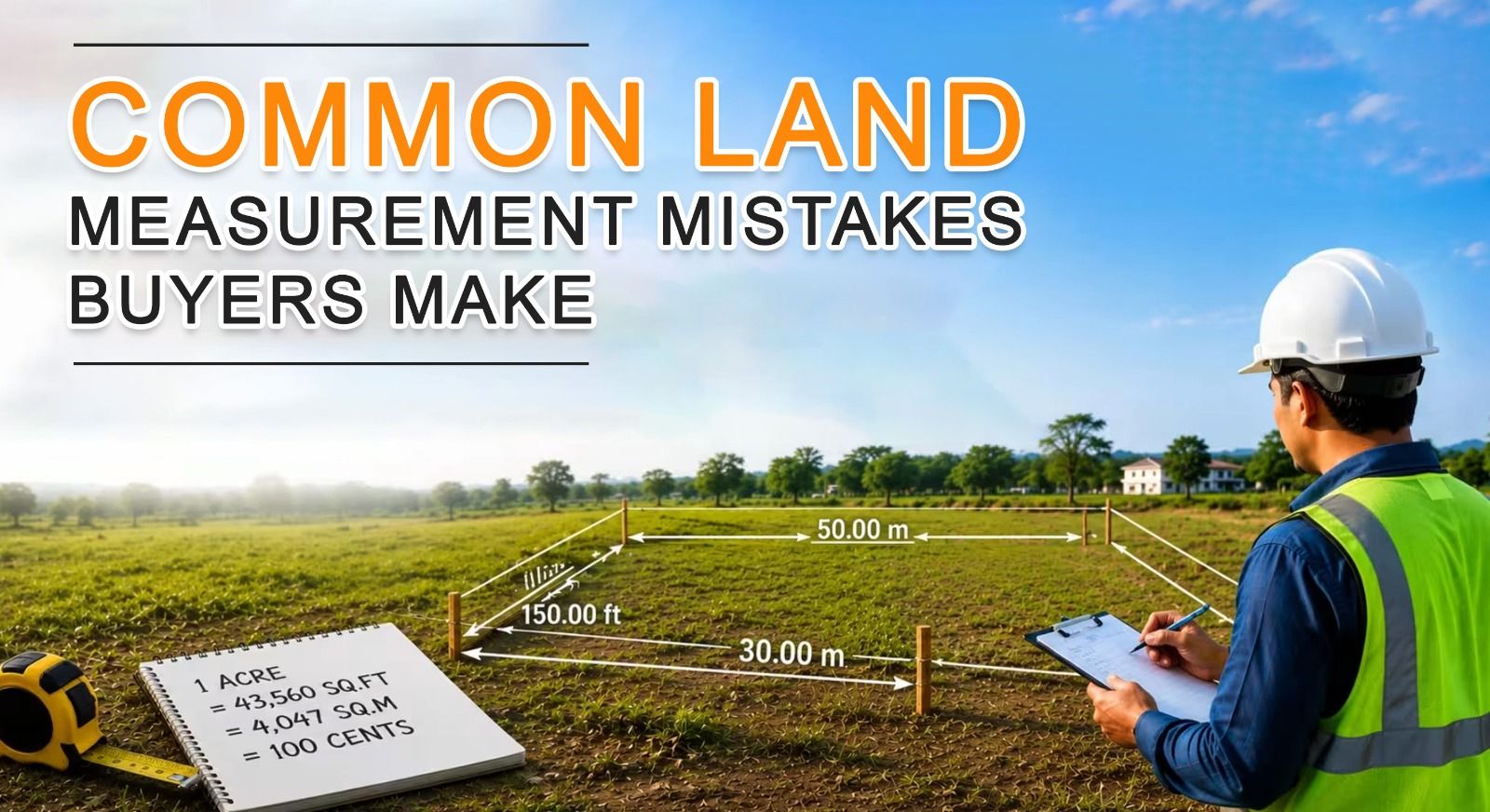
Buying land is exciting. At the same time, it's easy to overlook small details that later become expensive problems.
Here are some of the most common mistakes buyers make.
Assuming Every Bigha Is the Same
This is probably the biggest mistake.
As you've already seen, one Bigha does not have a fixed size across India. Never calculate the total price based on assumptions.
Ignoring Official Records
Some buyers rely only on what the broker says.
A better approach is to compare the seller's claim with the official land records. Even a small difference in measurement can affect the property's value.
Not Asking for a Survey
Boundary disputes are surprisingly common.
If you're purchasing agricultural land or a large plot, consider getting the property surveyed by an authorised surveyor before completing the transaction.
It provides clarity about the exact boundaries.
Confusing Built-up Area with Plot Area
Many first-time buyers confuse these two terms.
A residential plot may measure 200 Gaj, but the built-up area of the house constructed on it could be entirely different.
Always understand which measurement is being discussed.
Comparing Prices Without Converting Units
Suppose one property is priced per Acre and another per Bigha.
Without converting both into a common unit, comparing prices isn't meaningful.
It would be like comparing kilometres with miles.
A Real-Life Situation Many Buyers Face
A family looking for a farmhouse visited three different properties over a weekend.
The first owner quoted the land in Acres.
The second seller used Bigha.
The third property dealer spoke only in Gaj.
By Sunday evening, everyone was confused.
So they opened a simple conversion calculator, converted every property into square feet, and suddenly the comparison became much easier.
Interestingly, the plot that initially looked expensive turned out to offer the best value.
Sometimes, clarity comes from using a common measurement—not from negotiating harder.
And that matters more than glossy brochures or persuasive sales pitches.
Why Square Feet Is Often the Best Unit for Comparison
Property buyers often ask:
"Which measurement should I use while comparing different plots?"
The answer is simple.
Convert everything into square feet or square metres.
These units are standard, easy to verify, and commonly used by banks, architects, valuers, and government authorities.
Once every property is converted into the same unit, comparing prices becomes straightforward.
Understanding Government Records
Most state governments now maintain digital land records, making it easier for buyers to verify ownership and measurements.
Before purchasing, check whether the property details match:
Owner's name
Survey number
Plot size
Land classification
Mutation status
Encumbrances (if any)
Spending a little time reviewing these records can prevent future legal complications.
Land Measurements and Investment Decisions
Land measurements don't just affect documentation—they also influence investment decisions.
For example, if two plots are priced similarly but one offers a larger usable area after conversion, it may provide better long-term value.
As per recent housing demand trends across several growing cities and emerging corridors in India, buyers are increasingly comparing properties based on transparent measurements rather than local terminology. This shift reflects a growing preference for clarity, especially among first-time investors.
That's one reason why understanding land measurements has become more important than ever.
Planning to Buy Land? Keep This Checklist Handy
Before making any payment, take a few minutes to go through this checklist:
✔ Confirm the exact land measurement.
✔ Ask which unit has been used.
✔ Convert the area into square feet or square metres.
✔ Match the measurement with official records.
✔ Verify ownership documents.
✔ Check for any legal disputes or encumbrances.
✔ Visit the site personally.
✔ Measure the boundaries if required.
✔ Consult a legal or property professional when needed.
A little preparation today can save significant time, money, and stress tomorrow.
Recommended Tools for Property Buyers
Some online tools can make your property search more organised.
You may consider using:
Land area conversion calculators
EMI calculators
Stamp duty calculators
Property valuation tools
Home loan eligibility calculators
These tools don't replace professional advice, but they can help you make more informed decisions before signing any agreement.
Frequently Asked Questions
Is one Bigha equal across India?
No. The size of one Bigha varies from state to state and sometimes even between districts. Always verify the local standard before calculating the property's value.
What is the difference between Gaj and Square Yard?
There is no difference.
One Gaj is equal to one Square Yard, which is equal to nine square feet.
Which land measurement unit is used in government records?
Most government departments use metric measurements such as square metres and hectares, although traditional units may still appear in some revenue records.
Which unit is best for comparing land prices?
Square feet or square metres are generally the easiest units for comparing properties because they follow standard measurements.
Can I rely only on a broker's land measurement?
No.
Always verify the area using official documents and, if necessary, an authorised survey before completing the purchase.
Buying land is more than choosing the right location or negotiating the best price. Understanding how land is measured is equally important.
Whether someone quotes the area in Bigha, Acre, Katha, Gaj, Square Feet, or Square Metres, take a moment to understand what those numbers actually mean.
A few minutes spent verifying measurements today can help you avoid costly misunderstandings tomorrow.
At Land2Land, we believe informed buyers make confident decisions. Our goal is to simplify property information so that every buyer—whether purchasing a residential plot, agricultural land, or commercial property—can move forward with clarity.
Author Bio
The Land2Land Editorial Team creates practical, research-backed property guides designed for Indian homebuyers, land investors, and real estate enthusiasts. Every article focuses on simplifying complex property topics into clear, reliable information that readers can use with confidence.
Founder's Note
Real estate decisions often begin with questions, and our mission is to provide answers that are easy to understand and genuinely useful. At Land2Land, we believe transparent information builds trust. Whether you're buying your first plot or expanding your investment portfolio, we're here to help you make informed property decisions every step of the way.