You put your land up for sale, uploaded a few photographs, mentioned the location and price, and waited for the calls.
But nothing much happened.
Maybe a few people called. They asked about the price, location or road access and then disappeared. Perhaps someone even visited the property but never came back with an offer.
It can be frustrating. And after a few months, the obvious question comes up: Why is my land not selling?
Before reducing the price, take a step back.
In many cases, the problem is not the land itself. It could be the way the property is priced, photographed, described or presented to buyers. Today's land buyers have plenty of options. They compare several properties before deciding which ones are worth a site visit.
A vague listing can easily be ignored, even when the underlying property is good.
If you are trying to sell land, here are ten common reasons your property may be getting rejected by buyers, along with some practical ways to improve the situation.
1. The Asking Price Is Higher Than the Market
Let's start with the most obvious one: price.
Landowners naturally have an emotional connection with their property. They may remember what they paid for it, the money spent on development or the price a neighbour received for a similar parcel several years ago.
Buyers see things differently.
They compare your property with other land available in the same area.
Suppose comparable land is being offered at around ₹20,000 per square yard, while your asking price is ₹28,000. There may be a perfectly valid reason for the difference. Perhaps your land has better road frontage, a wider approach road or a more favourable location.
If those advantages are not obvious, though, a buyer may simply skip the listing.
So, before changing the price, check recent comparable listings in the same micro-market. Look at properties with similar size, access, land use and location.
Also remember that an asking price is not necessarily the final market value.
A realistic price can bring serious conversations. An unrealistic one can leave a property sitting online for months.
2. The Location Information Is Too Vague
"Land available in Gurgaon. Contact for details."
It sounds like a listing, but it does not really help a buyer.
When people search for land, location is usually one of their first filters. They want to know not just the village or locality but what is actually around the property.
How far is the main road?
Is there a proper approach road?
How far is the nearest highway?
Are there residential projects, industrial areas or established settlements nearby?
What is the approximate distance from important landmarks?
These details matter because a buyer is trying to picture the property before deciding whether a site visit is worth the time.
Instead of simply writing a locality name, explain the location clearly and use only information that can be verified.
For example:
"The property is located approximately 3 km from the main highway and has road connectivity to the nearby residential and commercial areas."
That is far more useful than "prime location".
And words such as prime, excellent and best location do not mean much unless you explain why.
3. Your Photographs Are Not Helping You Sell
A blurry photograph taken from inside a car is not going to give a buyer much confidence.
It sounds obvious, yet poor photographs remain a common problem with online land listings.
A buyer may never visit your property if the listing does not give them a basic idea of what they are considering.
Try to show the property from different angles. Include the entrance, approach road, road width, boundaries, nearby development and surrounding area.
If there is electricity infrastructure or another visible feature that is genuinely relevant, show that too.
A simple location map or site map can also help.
Most importantly, keep the photographs accurate. Do not heavily edit them or use pictures from another property.
A buyer who reaches the site and finds that the photographs were misleading is unlikely to trust anything else in the listing.
4. Important Property Details Are Missing
Imagine finding a property online and having to call the seller just to find out its size.
That creates unnecessary friction.
A useful land listing should answer most basic questions upfront.
Mention the land area clearly. Use a familiar measurement and, where useful, provide the equivalent in another unit.
Also mention the property type, location, asking price, road access and ownership details.
If appropriate, the listing can also explain whether relevant documents are available for verification.
For example:
Land area: 2 acres
Location: [Village/Locality, District, State]
Land type: Agricultural land
Road access: [Verified road width]
Asking price: ₹[Amount]
Ownership: [Single/Joint, if relevant]
The idea is simple: make it easier for a genuine buyer to decide whether the property fits their requirement
5. The Documentation Is Unclear
This is where many promising conversations stop.
A buyer may like the location and even be comfortable with the price. But once questions about ownership and records begin, uncertainty can quickly change their mind.
Depending on the state and property, buyers may want to examine documents relating to title, previous sale transactions, revenue records, mutation, encumbrance, boundaries, access rights and land-use status.
The exact requirements vary. Agricultural land can involve additional considerations depending on local laws and permitted use.
That is why sellers should organise the relevant paperwork before actively marketing the property.
If there is an issue with the title, boundary or access, do not assume that it will somehow disappear during the transaction.
It is better to have the matter reviewed by a qualified property lawyer or appropriate professional before making promises to buyers.
Clear documentation does not guarantee a sale. It does, however, make the verification process much easier.
6. You Are Reaching the Wrong Buyers
Not every buyer is looking for the same kind of land.
Someone searching for agricultural land may have completely different requirements from a buyer looking for commercial land, a warehouse site or land for a permitted farmhouse use.
This is where a generic listing can fall short.
Think about who is actually likely to be interested in your property.
A large parcel near an industrial area may attract a different audience from a small agricultural plot in a rural location. Likewise, roadside land may have a different buyer profile from land deep inside an agricultural belt.
Of course, the buyer's intended use must always comply with applicable land-use rules and permissions.
The more clearly you understand the likely buyer, the easier it becomes to write a useful listing.
You are not trying to attract everyone.
You are trying to attract the right people.
7. Your Listing Does Not Explain the Property's Real Advantage
A land listing should answer one basic question:
Why should a buyer consider this property?
The answer should be based on facts, not hype.
Perhaps the land has good road frontage. Maybe it has an easy approach, a regular shape or is close to an established settlement.
There may be verified infrastructure nearby. Perhaps the property is located close to an existing commercial or residential area.
Mention those things.
But be careful with future-growth claims.
Saying that an area has seen infrastructure development is different from promising that a particular road, metro line or project will definitely increase the property's value.
Likewise, "potential for future growth" is very different from "guaranteed appreciation".
Serious land buyers usually appreciate facts more than sales slogans.
8. The Listing Has Been Sitting Online for Too Long
There is a psychological side to property listings.
If buyers see the same property online for six months with the same photographs and the same description, some may start wondering why it has not sold.
That does not mean an old listing is necessarily a bad property.
However, it is worth reviewing the listing from time to time.
Has the surrounding area changed?
Is there new infrastructure that can be verified?
Are the photographs still current?
Is the asking price still competitive?
Have you clearly explained the access road?
A listing refresh does not mean changing everything every week. It simply means keeping the information accurate and relevant.
And if you reduce the price, explain the updated price clearly rather than creating confusion with multiple conflicting figures.
9. You Are Responding Too Slowly
This one is easy to overlook.
Suppose someone finds your land at 11 in the morning and sends an enquiry. They are probably looking at several other properties at the same time.
If your response comes two days later, they may already have shortlisted another property.
You do not need to pressure a buyer into booking the land.
A simple, timely response is enough.
For example:
"Thank you for your enquiry. The property is currently available. Please share your preferred budget and intended use, and we can provide the relevant property details."
That keeps the conversation open.
It also helps you identify whether the enquiry is genuine.
10. Buyers Cannot Easily Verify the Property
Eventually, every serious land buyer reaches the same stage: verification.
They want to know whether the land is actually where the listing says it is. They want to confirm the area, ownership, access and applicable use.
They may ask:
Does the documented land area match the listing?
Is the approach road clear?
Is the seller authorised to sell?
Are there any known disputes or encumbrances?
What use is legally permitted?
Do the property boundaries match the records?
These questions are normal.
They should not be treated as a lack of trust. A land purchase is a significant financial decision, and due diligence is part of the process.
For sellers, the best approach is to provide accurate information and cooperate with reasonable verification.
For buyers, an online listing should be treated as the beginning of the process, not proof that everything about a property has been verified.
Why Is My Agricultural Land Not Selling in India?
This is a question many landowners ask after their property has remained unsold for a long period.
Agricultural land can have a narrower buyer pool than standard residential property. In addition, buyers may want to understand revenue records, ownership, road access and restrictions on land use before moving forward.
If you are asking why is my agricultural land not selling in India, start with four simple checks.
Check the price
Compare your asking price with similar agricultural properties in the same area.
Make sure the relevant ownership and revenue records are organised and available for proper verification.
Check access
A buyer needs to know how they will reach the property. Clearly explain the approach road and its verified width.
Check the presentation
Does the listing explain the land area, location, surroundings, access and price without making the buyer chase you for basic information?
Sometimes these small improvements make a bigger difference than simply cutting the asking price.
How to Make Your Land Listing Attractive to Buyers
A good listing does not have to sound like an advertisement.
In fact, simple language can work better.
Compare these two descriptions.
"Golden opportunity! Best land investment! Huge future returns guaranteed!"
Now compare it with:
"Agricultural land available near [location], measuring [area], with [verified road width] access. The property is approximately [distance] from [verified landmark]. Relevant ownership documents are available for verification."
The second description is less exciting, but it gives a buyer something useful.
That is the point.
When people search for how to make a land listing attractive to buyers, the answer is not necessarily more adjectives. It is better information.
Use recent photographs. Give accurate measurements. Explain the location. Mention genuine advantages. Keep the price clear.
And if there is something important that a buyer should know, do not hide it.
Common Mistakes When Selling Land Online
Some common mistakes when selling land online are surprisingly basic.
Using different prices on different websites is one.
If the same property is listed at ₹2 crore on one platform and ₹2.5 crore somewhere else, buyers may question the listing itself.
Another mistake is using old photographs or photographs that do not clearly show the property.
Some sellers also leave out the exact location and provide only a vague landmark.
Then there are listings that promise guaranteed returns or future development without any reliable basis.
Avoid all of these.
The goal of an online property listing is not simply to generate clicks. It is to generate the right enquiries.
And that means accuracy matters.
A Small Change That Can Make a Big Difference
A landowner once spends weeks waiting for calls and then decides the price must be the problem.
But before reducing the price, try reading your own listing as if you were the buyer.
Could you understand where the land is?
Could you estimate the total cost?
Could you understand the road access?
Could you see the property properly from the photographs?
Could you tell what documents are available?
If the answer to several of these questions is "no", you have probably found the first thing that needs fixing.
That is an important distinction.
Sometimes a property does not need a lower price. It needs a better presentation.
When Should You Consider Professional Help?
Selling land is not quite the same as selling a ready-to-move apartment.
There can be more questions around land records, access, boundaries, permitted use and documentation. At the same time, the seller needs to find buyers who are actually interested in that type of land.
This is where a specialised land platform can help.
Land2Land focuses on bringing landowners and prospective land buyers together through property listings that make important information easier to understand.
For a seller, the objective should not simply be to put the property everywhere.
It should be to put the property in front of the right audience with information that answers genuine buyer questions.
If your land has been sitting unsold, ask yourself one more question before lowering the price:
"Have I made it easy enough for the right buyer to understand this property?"
That question is often worth answering first.
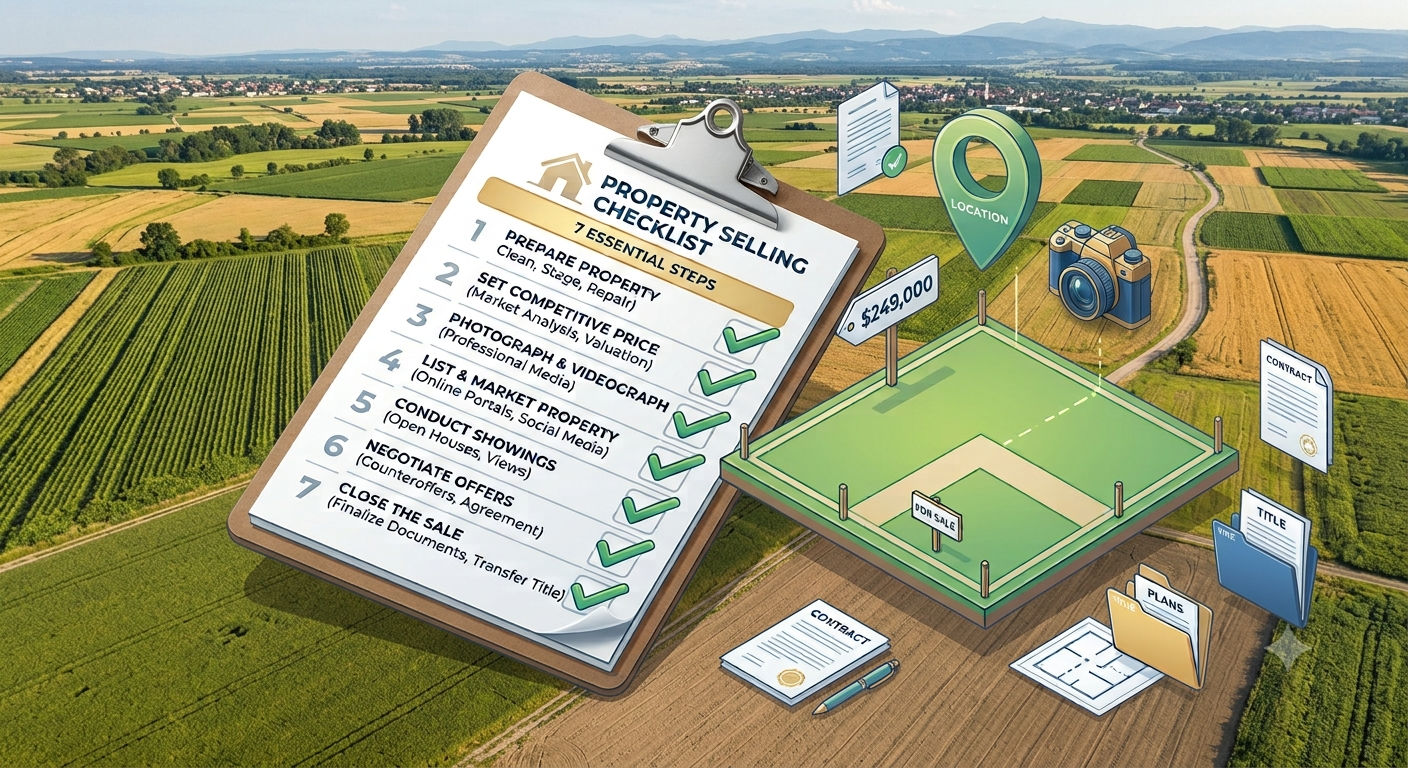
7-Point Checklist Before You Relist Your Land
Before you publish the property again, check these seven things:
Price: Is the asking price in line with comparable properties?
Location: Is the location easy to understand?
Photographs: Are the images recent, clear and genuine?
Land area: Is the measurement accurate and consistent?
Documents: Are the relevant records organised for verification?
Access: Have you clearly explained the approach road?
Buyer: Are you reaching people who actually need this type of land?
If you can answer yes to all seven, your listing is already in a better position.
Final Thoughts
An unsold land problem does not automatically mean the property is bad.
Sometimes the price is too high. Sometimes the listing does not provide enough information. Sometimes the photographs are poor. And sometimes buyers simply do not have enough confidence to take the next step.
The good news is that most of these issues can be reviewed.
Start with the basics: price, location, photographs, documentation and clear communication.
Then think about the buyer.
What would you want to know before spending your time travelling to the property?
What would you want to verify before making an offer?
Answer those questions in the listing itself.
If you are trying to sell land fast in India, avoid shortcuts such as exaggerated appreciation claims or unrealistic promises. They may attract attention, but they do not necessarily attract serious buyers.
Good land selling is ultimately about trust.
At Land2Land, the aim is to make land discovery simpler, property information clearer and the connection between genuine sellers and buyers more useful.
Because sometimes the land is not the problem.
The listing simply has not answered the buyer's questions yet.
Frequently Asked Questions
Why is my land not selling?
The most common reasons include an unrealistic asking price, poor photographs, unclear location information, incomplete documentation, limited buyer targeting and a listing that does not explain the property's genuine advantages.
How can I sell land faster?
Start by checking your price against comparable properties. Then improve the photographs, provide accurate location details, organise the relevant documents and reach buyers who are actually looking for that type of land.
What should I include in a land listing?
Mention the land area, location, land type, asking price, road access, nearby landmarks and relevant ownership or documentation information. Clear photographs are also important.
Why is agricultural land difficult to sell?
Agricultural land may have a more specific buyer pool. Buyers may also need to check land records, ownership, access and applicable land-use rules before proceeding.
How do I make my land listing attractive to buyers?
Use clear photographs, accurate measurements, straightforward location details and an honest description of the property's features. Avoid unsupported claims about guaranteed returns.
Should I reduce the price if my land is not selling?
Not necessarily. First understand why buyers are not progressing. Compare the price with similar properties and review the listing, photographs, documentation and access information before deciding whether a price change is necessary.
Is selling land online safe?
Online platforms can help sellers reach prospective buyers, but the transaction still requires proper due diligence. Ownership, title, land records, access, permitted use and applicable legal requirements should be independently verified before completing a transaction.
About Land2Land
Land2Land is a land-focused property platform that helps landowners and prospective buyers discover and evaluate land opportunities.
Our focus is on making property information easier to understand and helping genuine buyers and sellers connect with greater clarity.
Author Bio
Land2Land writes about land, property markets and real-estate topics in India, with a focus on practical information for property owners and buyers. The aim is to explain complex property-related topics in simple, useful language and help readers ask the right questions before making a property decision.
Founder's Note
A Note from the Founder of Land2Land
Land is a significant asset, and buying or selling it should not be based on unclear information or unrealistic promises.
At Land2Land, we believe that better information leads to better conversations between buyers and sellers. Our aim is to make land discovery more transparent by helping property owners present relevant information clearly while giving prospective buyers a better starting point for their research.
We also encourage buyers to conduct proper due diligence and verify property records before making any financial commitment.
A property marketplace should be more than a collection of listings. It should help people make sense of those listings.
That is the approach we are working towards at Land2Land.