Buying a plot can look easy from the outside. You find a good location, compare the price with nearby properties, speak to the seller and, if everything feels right, you may be tempted to pay a token amount.
But there is one part of buying land that should never be rushed: checking the documents.
A plot may look perfect when you visit it. The road may be good, houses may be coming up nearby and the price may even seem like a great deal. Still, none of that tells you whether the seller actually has a clear right to sell the property.
This is why knowing the documents to check before buying land is so important.
The paperwork can seem confusing at first. You may come across terms such as title deed, mutation, Encumbrance Certificate, khasra number, survey records and land-use classification.
Don't worry. You do not need to understand every legal term in one sitting.
What matters is knowing what each document is meant to establish and making sure the information across different records matches.
Why Should You Check Land Documents Before Buying?
A land purchase is usually a long-term financial commitment. Once the registration is completed, resolving a documentation problem can be difficult, expensive and time-consuming.
Consider a simple situation.
You find a plot at a price that is noticeably lower than similar properties nearby. The seller says the documents are clear and asks you to pay a token amount quickly because another buyer is interested.
It sounds tempting.
However, during verification, you discover that the plot number mentioned in one document does not match another property record.
At this point, the sensible step is not to negotiate harder. It is to find out why the records do not match.
Sometimes a mismatch may be a genuine clerical issue. Sometimes it can point to something much more serious.
That is why document verification should happen before you commit a significant amount of money.
Documents to Check Before Buying Land
There isn't one document that tells you everything about a property.
Instead, buyers should look at several records together.
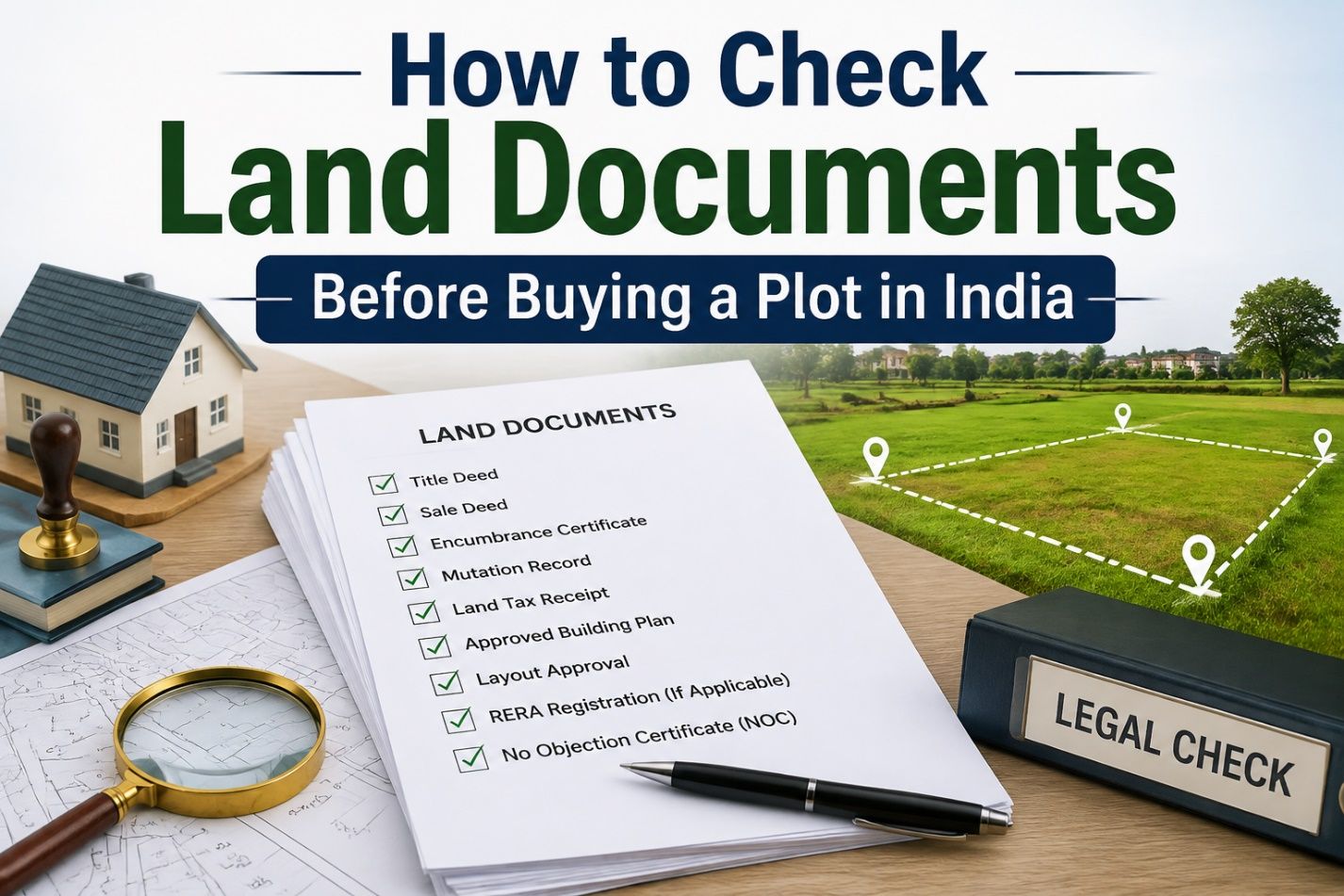
The important documents and records generally include the title deed, previous ownership documents, mutation records, Encumbrance Certificate, survey or revenue records, land-use details and applicable development or layout approvals.
The exact terminology and procedure can vary between Indian states and local authorities. Therefore, always check the rules that apply to the specific property you are considering.
Let's look at the important documents one by one.
1. Check the Title Deed
The title deed should be one of your first checks.
It helps establish the seller's ownership and provides important details about the property.
Look at the owner's name, property description, area, boundaries, plot or survey number and registration details.
Then compare these details with the information in other available records.
Pay particular attention to the property identification number.
A buyer might see a beautifully developed plot during a site visit, but the paperwork needs to identify that exact property.
If the seller's name, plot number, area or boundaries do not match, don't ignore the difference.
Ask for clarification and have the documents independently reviewed.
2. Check the Previous Ownership Documents
The current seller may not have purchased the property directly from the original owner.
Perhaps the land has changed hands several times.
Perhaps it was inherited.
Perhaps it was transferred through a gift, family settlement or another legally recognised transaction.
This is why the chain of ownership matters.
Ask for the relevant previous documents and check whether the ownership history can be properly established.
For example, if Seller B bought the property from Seller A, there should be a valid document showing that transfer. If Seller A acquired it from someone else, that earlier transaction may also need to be examined.
This is one area where professional legal advice can be extremely valuable.
3. Check Mutation Records
Mutation is another term buyers frequently encounter.
In simple terms, mutation records reflect a change in ownership or related details in the relevant revenue records after a property transfer.
However, there is an important point to remember:
Mutation is not the same thing as title.
A mutation entry should be checked along with the title documents and other relevant records.
Check whether the seller's name is correctly reflected and whether the property details correspond with the documents you have already examined.
If the seller says that mutation has been completed, ask for the relevant record rather than relying only on a verbal statement.
4. Obtain an Encumbrance Certificate
An Encumbrance Certificate (EC) is another important document in property due diligence.
Depending on the registration system and period covered, an EC can help identify certain registered transactions or encumbrances associated with a property.
For example, it may reveal registered transactions or certain charges such as a mortgage recorded against the property.
This matters because you don't want to discover after purchasing a plot that there is a registered financial claim connected to it.
Ask for an EC covering an appropriate period and have it reviewed carefully.
At the same time, don't treat an EC as a guarantee that absolutely no dispute can ever exist. Its value depends on the records covered and the period for which it has been issued.
For a major investment, it should form part of a wider legal verification process.
5. Verify Survey, Khasra and Land Records
Now comes a check that buyers sometimes overlook because it seems technical.
The plot on the ground should match the property described in the official records.
Depending on the state, you may encounter terms such as survey number, khasra number, plot number or other land identification details.
Check:
Property identification number
Total area
Dimensions
Boundaries
Village or locality
Adjacent properties
Access road
If there is any doubt about the actual boundaries, consider getting the property professionally measured.
A small difference on paper can become a very large problem when construction starts.
6. Check the Land-Use Classification
This is particularly important when buying land in developing areas.
Find out how the property is officially classified.
Is it residential?
Agricultural?
Commercial?
Industrial?
Is it located within a controlled area or another regulated zone?
Never assume that a plot can be used for any purpose simply because houses or commercial buildings are visible nearby.
For example, agricultural land may be considerably cheaper than residential land. A buyer may therefore think, “I'll purchase it now and convert it into residential land later.”
That may or may not be possible.
Conversion requirements vary by state and location, and additional permissions or restrictions may apply.
So, before purchasing, verify the land-use status with the appropriate authority.
7. Check the Approved Layout and Permissions
If you are purchasing a plot in a plotted development or colony, don't rely only on the brochure.
Ask to see the applicable approved layout and permissions.
Compare the plot being offered with the approved plan.
Look at the plot number, dimensions, roads, common areas and other relevant details.
For instance, a brochure may show a wide road in front of the plot. The approved plan and actual site conditions should support what is being represented.
This is another reason why visiting the property yourself is important.
8. Check Property Tax and Other Dues
Before completing the purchase, find out whether there are outstanding property taxes or other applicable dues.
Depending on the property and local authority, there may be different types of charges to verify.
Ask for relevant receipts or records and confirm whether payments are up to date.
It is better to discover an unpaid liability before registration than after becoming the owner.
9. Verify the Seller's Identity and Right to Sell
The person negotiating the sale is not necessarily always the sole legal owner.
This becomes especially important with inherited properties, jointly owned land, properties involving multiple legal heirs, companies, trusts or Power of Attorney arrangements.
Verify the seller's identity against the property records.
If there are multiple owners, understand who needs to participate in the transaction.
If somebody is acting on behalf of the owner, verify their legal authority.
This step may feel unnecessary when the seller appears trustworthy.
Do it anyway.
Property transactions should be based on documents, not just personal confidence.
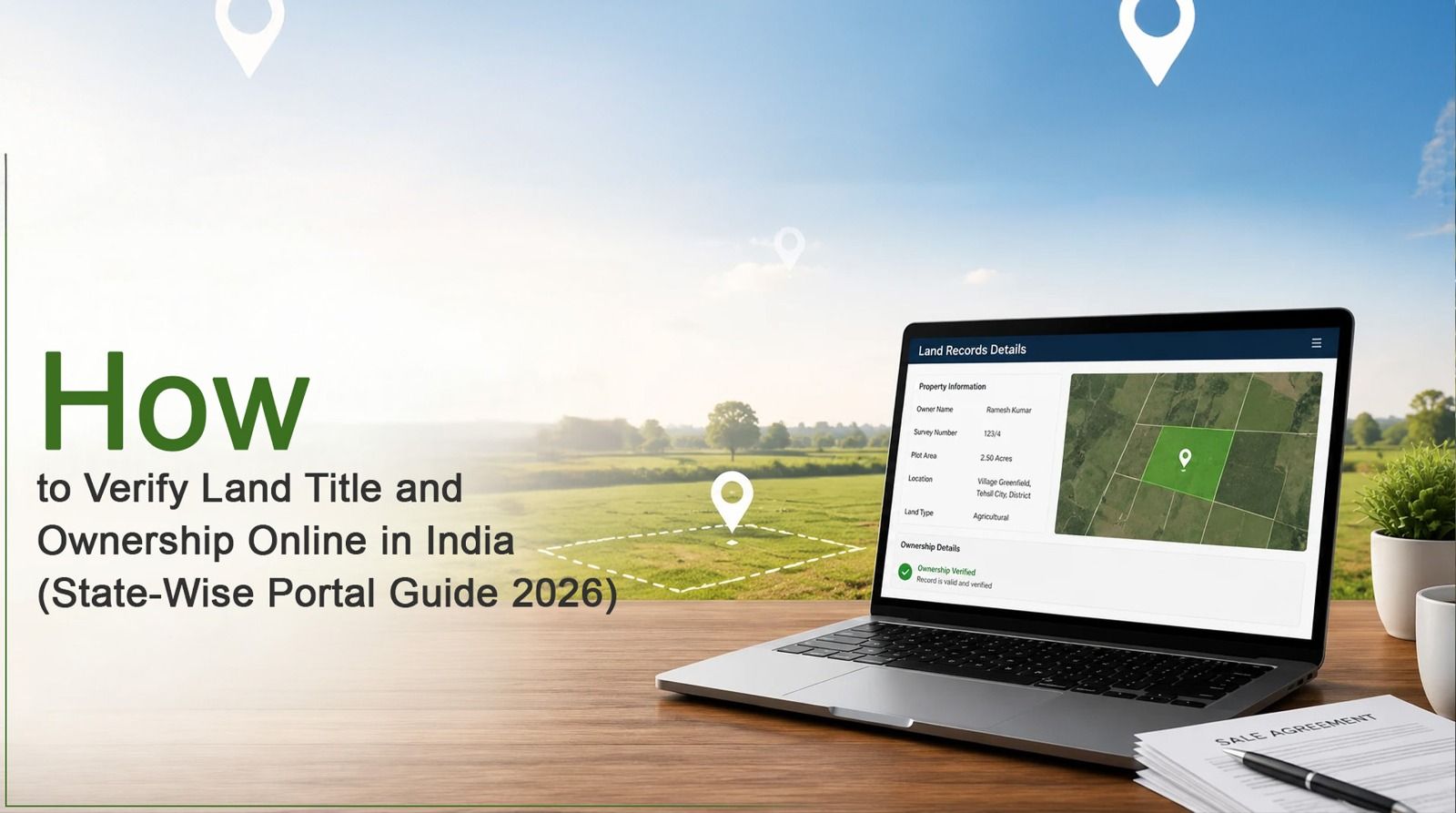
How to Verify Land Ownership Online
Many states provide online access to land and revenue records through official government portals.
Depending on the state, you may be able to search using information such as the owner's name, survey number, khasra number, village, district or other property details.
Online records can be extremely useful for an initial check.
However, don't stop there.
Compare online information with the registered documents and physical property details. If something doesn't match, investigate the difference.
Also make sure you are using the official government portal, rather than relying on an unofficial website that simply republishes property information.
A Simple Way to Check Whether the Documents Match
Think of the process as connecting the dots.
The seller's name should make sense across the ownership documents.
The survey or plot number should identify the same property.
The area should be reasonably consistent.
The boundaries should correspond.
The land-use classification should match the intended purchase.
The registered history should not reveal an unresolved issue that has been ignored.
And finally, the property you see on the ground should actually correspond to the property described in the paperwork.
If one piece doesn't fit, stop.
Don't assume the problem will somehow disappear after registration.

Common Mistakes Buyers Make
Even careful buyers sometimes make mistakes because they become emotionally attached to a property.
One common mistake is checking only the current sale deed.
Another is trusting the seller's statement that “everything is clear” without independently verifying it.
Some buyers also focus heavily on location and price while giving very little attention to land-use classification.
Then there are buyers who pay a large token amount before completing basic due diligence.
There is no need to rush.
A good property should survive a proper document check.
A Practical Process for First-Time Buyers
If this is your first land purchase, keep the process simple.
First, verify the seller and title.
Next, trace the ownership history.
Then, check mutation and relevant revenue records.
After that, obtain the applicable Encumbrance Certificate and investigate any registered claims.
Now compare the survey or khasra details with the actual property.
Then check land use, development permissions and layout approvals where applicable.
Finally, have an independent property lawyer review the documents before you complete the transaction.
The cost of professional advice may feel like an additional expense at the beginning.
In reality, it can be one of the most useful expenses in the entire purchase.
A 2026 Reminder for Land Buyers
In 2026, property information is easier to find online than ever before. Buyers can compare prices, explore locations and access many government records from their phones or computers.
That convenience is useful.
However, it can also create false confidence.
Seeing a property on a map or finding an online record does not replace proper legal due diligence.
Land records, planning rules, registration procedures and conversion requirements can also differ between states and local authorities.
Therefore, before making a large financial commitment, verify the current rules applicable to the exact property.
Final Thoughts
Buying a plot is exciting, but the paperwork should never become an afterthought.
The location can change.
The market can change.
Prices can rise or fall.
But a serious ownership or title problem can follow the property for years.
That is why the documents to check before buying land should include the title deed, ownership history, mutation records, Encumbrance Certificate, survey or revenue records, land-use classification and applicable approvals.
Don't rely only on what the seller says.
Don't rely only on a property brochure.
And don't assume that a low price automatically means you have found a great deal.
Check the documents first. Understand what you are buying. Then decide whether the property is worth your money.
If you are also comparing different types of land before investing, you can read our guide on Agricultural Land vs Residential Land: Which Is a Better Investment in 2026? It explains the differences in returns, restrictions, conversion, liquidity and long-term potential.
Frequently Asked Questions
What are the documents to check before buying land in India?
Important documents generally include the title deed, previous ownership documents, mutation records, Encumbrance Certificate, survey or revenue records, land-use information and applicable layout or development approvals. The exact requirements can vary by state.
How can I verify the ownership of a plot?
Start by checking the registered title documents and the relevant government land or revenue records. Compare the owner's name, property identification number, area and boundaries. For an important transaction, get the title independently reviewed by a property lawyer.
What is a mutation record?
Mutation records reflect a change in ownership or related details in the applicable revenue records. However, mutation should not be treated as a substitute for proper title verification.
Why is an Encumbrance Certificate important?
An Encumbrance Certificate can help identify certain registered transactions or encumbrances for the period covered. It is useful during property due diligence but should be considered alongside other documents rather than as the only proof that a property is risk-free.
How do I check whether a plot is residential or agricultural?
Check the applicable official land-use and planning records. Do not rely only on the seller's description. Depending on the location, agricultural land may require conversion or other permissions before residential use is permitted.
Should I hire a property lawyer before buying land?
For a significant land purchase, independent legal advice is strongly recommended. A property lawyer can review the title chain, ownership records, encumbrances, land-use issues and other documents that may be difficult for a first-time buyer to assess.